Modern software development is frequently bottlenecked at the infrastructure level. Database architecture is typically decoupled from the frontend, meaning engineers spend weeks designing schemas, creating migrations, setting up ORMs, writing mock APIs, manually seeding data, and mapping it all back to the client-side UI.
We designed Drawline.app precisely to obliterate this friction, transforming the backend design process from a sprawling labyrinth into an entirely visual, instantaneous pipeline.
The Protocol Bottleneck
In standard environments, creating a new service requires an orchestrated dance of Docker containers, SQL migrations, and API boilerplate (often GraphQL or REST). This means product iterations are gated behind backend availability. Without a live API contract, frontend engineers inject hard-coded JSON payloads into React components, guaranteeing structural drift the second the backend solidifies its implementation.
Visual Relational Schemas
Drawline introduces a drag-and-drop node-based interface that functions as your ground-truth schema representation. When you connect a User node to a Post node, the underlying engine immediately synthesizes a one-to-many relationship, defining Foreign Keys, indexes, and cascades. You get direct visual feedback of your entire relational model.
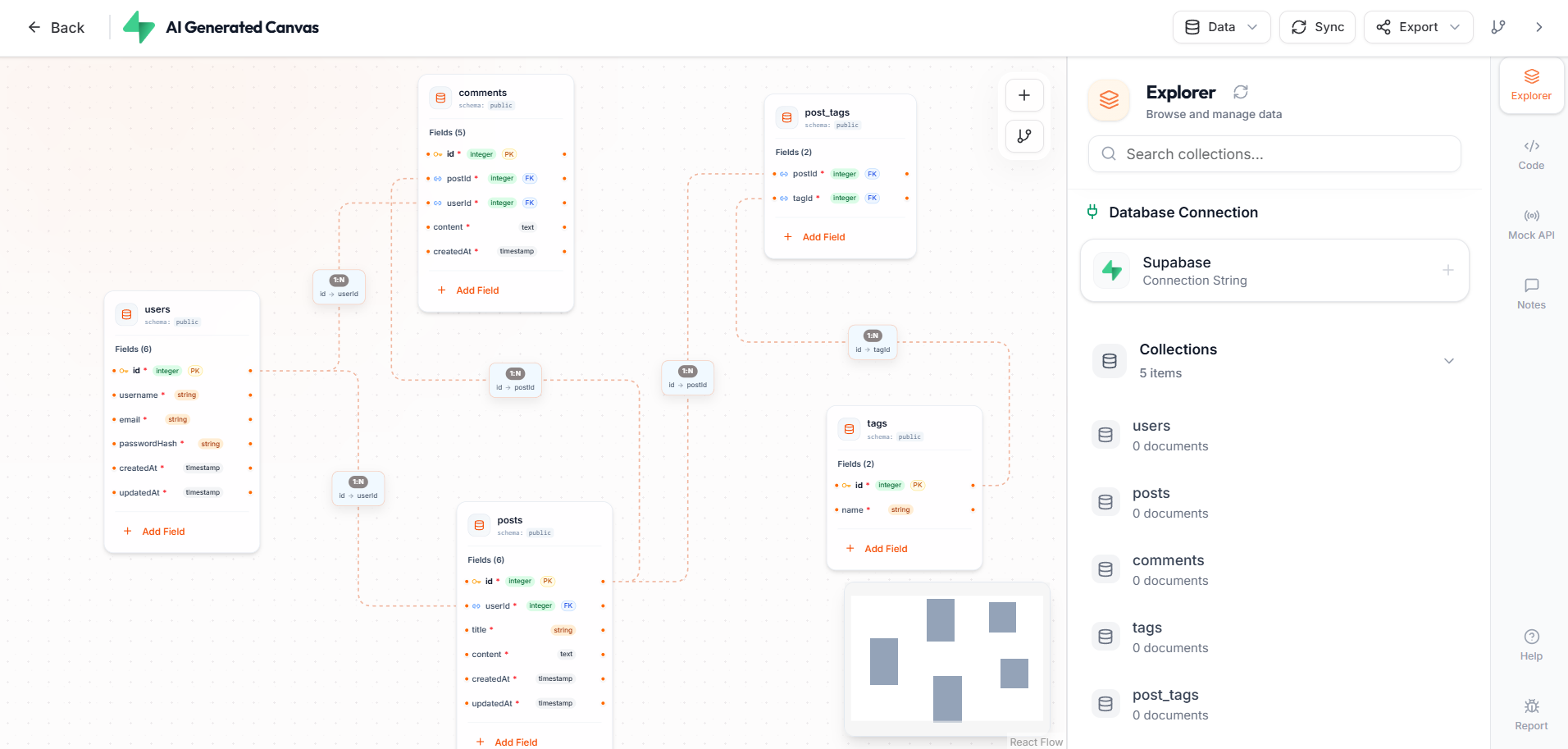
The Result: Unifying Teams
For the engineering ecosystem at Solvara, drawing the architecture is building the architecture. The moment the architecture is mapped, frontend teams receive a dynamically generated network request API introspectable via the endpoint.
The days of waiting on DevOps or backend iterations are over. By elevating databases to a purely visual syntax, we dramatically cut down infrastructure management and restored the flow state of pure product engineering.